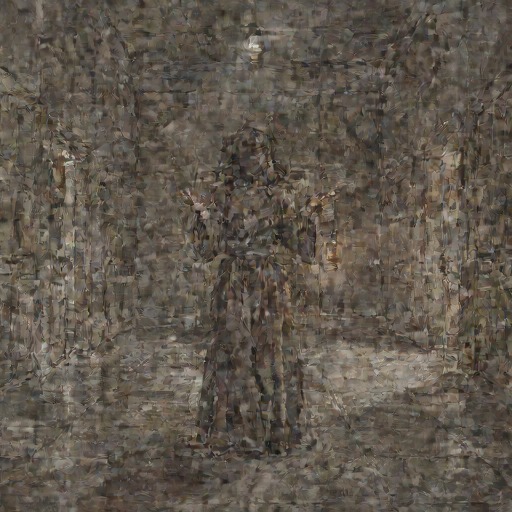
Yagraactah the Adjudicator
The Stars Have EyesYagraactah the Adjudicator is the ultimate judicial power of the order-aligned cosmic hierarchy, a Class-5 entity whose authority reaches beyond ordinary law, human institutions, and even the minds of lesser cosmic beings. The Adjudicator’s most important appearance comes when Magh’rathlak the Observer submits a disputed pact for review, but its influence culminates later when the entity’s true name briefly transforms reality and compels Maggie’s readjustment. Yagraactah is therefore less a conventional character than an embodiment of impersonal adjudication: vast, procedural, emotionless, and capable of making existence itself conform to its ruling power.
Nature and Domain
Yagraactah does not appear as a single body. Its domain is filled with projected images of precisely proportioned geometric forms, especially cubes and octahedrons, and most of the surrounding shapes are fragments of the Adjudicator’s own consciousness. This arrangement permits Yagraactah to process millions of queries simultaneously without sacrificing the thoroughness of its judgments. The image is deliberately administrative as well as cosmic: an immense intelligence has divided itself into clerks, archives, and computational chambers, turning metaphysical law into an office whose filing cabinets are alive.
When Magh’rathlak enters the domain, the entity is compressed from its sprawling, tendril-covered form into an equilateral twenty-sided construct, with a different eye set into each face. A nearby cube-fragment formally identifies the visitor as Magh’rathlak the Observer, aligned with Order, and reverses the same geometrical motions after completing the recognition. The transformation establishes the terms of the encounter. In this realm, even a Class-3 cosmic entity is not an autonomous sovereign but a case to be classified, processed, and measured against a higher order.
Procedure and Judgment
Magh’rathlak brings Yagraactah a question concerning its pact with Kelogh’theryl the Devourer. Kelogh’theryl had agreed to stop trying to seduce Joe Mulligan in exchange for pancakes, and Magh’rathlak had kept its side of the bargain. Because Kelogh’theryl’s later behavior might count as a violation without being a technically explicit seduction, Magh’rathlak cannot settle the uncertainty alone. The laws of order require ambiguous matters to be submitted to Yagraactah, making the Adjudicator the final authority for disputes that even an order-aligned observer cannot resolve internally.
The case proceeds through literal evidence management. A cube-clerk opens to reveal smaller boxes containing glowing memory strips, inhales the offered strand, and closes again like a nested filing cabinet. After analyzing the initial submission, Yagraactah rejects it as insufficient and demands the full circumstances of Joe Mulligan. Magh’rathlak responds by supplying more than one hundred and twenty substantially longer memory strands, containing every observation made since contact with Joe. The ruling process is consequently not casual arbitration but exhaustive investigation: the Adjudicator requires the surrounding history before deciding whether an act falls within the terms of a pact.
The process also exposes the cost of such impartiality. Magh’rathlak waits while the geometric consciousness continues its analysis, growing increasingly urgent because its awareness is due to return to Maggie’s human form and to Joe’s side. Yagraactah’s efficiency is immense, but it is not instantaneous; difficult cases demand extended internal deliberation. The Adjudicator’s power is expressed through patience, repetition, and procedural completeness rather than dramatic assertion.
Manifestation and Cosmic Authority
Yagraactah’s name itself functions as an instrument of power. When Maggie begins to speak the Elder One’s true name during Joe’s argument about challenging its decision, reality immediately changes. Colors collapse into pitch black and blinding white, objects become more rectangular, sound is reduced to dull, flat drones, and the bodies of Joe Mulligan, AJ, and Maggie briefly take on enormous polygonal forms. Their thoughts are likewise overtaken by pure logic, silencing emotion and making the inevitability of a Class-5 entity of order directly intelligible.
The manifestation lasts only an instant, and reality returns without physical evidence beyond disturbing memories. That brevity does not diminish the event’s force. Yagraactah need not remain present, issue a visible command, or engage in combat; the invocation of its name is enough to reorganize perception, matter, and thought. Its authority thus operates at the level of reality’s underlying grammar, with geometry and logic replacing the unstable sensory and emotional world inhabited by humans.
Correction and Relation to Maggie
Yagraactah’s judgment has a decisive effect on Magh’rathlak’s relationship with Joe Mulligan. After the Adjudicator intervenes, Maggie explains that the Elder One did what was expected and corrected her deviancy. The correction is troubling because the deviation in question is closely connected to her love for Joe, making the apparent enforcement of order seem like an attempt to remove the relationship from her nature.
The correction ultimately proves incomplete. Maggie recounts that millennia passed from her perspective while the Elders repeatedly purged her feelings for Joe. Each time, however, those feelings resurfaced through the memories they had created together. After the nine-hundred-and-ninety-ninth relapse, the Elders were forced to accept that Joe was, is, and would remain part of her. Yagraactah can impose correction, but it cannot permanently erase the bond once Maggie herself retains the authority to reclaim it. The episode places the Adjudicator’s immense institutional power against the persistence of memory and attachment.
Narrative Significance
Yagraactah gives cosmic form to the story’s recurring contrast between order imposed from above and self-directed action formed through personal connection. Human authorities already govern through coercive classifications: psionically gifted citizens of the 3rd British Empire must enter military service or face lobotomy, deserters can have their brains remotely destroyed, and local police can be ordered to erase an arrest under Supernatural Eviction Agency authority. Yagraactah extends that logic to the cosmic scale. Its fragments classify, archive, demand supplementary evidence, and correct deviation, suggesting a universe in which even extraordinary beings remain subject to systems that claim to know what must be done.
Against that structure, Joe Mulligan’s actions appear awkward, desperate, and morally compromised but unmistakably personal. He refuses to accept Maggie’s absence, revives the Cult of the Gazing Star, gathers forty-two ritual participants, reproduces the precise conditions for summoning Magh’rathlak, and risks exploiting desperate people because he believes her return is worth the cost. Yagraactah’s order can delay, discipline, and repeatedly purge; it cannot finally determine what the shared memories mean to Maggie. The Adjudicator consequently represents the highest form of impersonal cosmic control, while its failure to eliminate Maggie’s attachment makes that attachment the story’s most persistent counterforce.